

Two days before the scandal around the alleged use of AI in a winning piece for the Commonwealth Short Story Prize, I’d written a new Mission Statement for TSS Publishing as a direct response to the rise of Artificial Intelligence and Large Language Models.
AI and LLMs have radically changed the literary landscape and what it means to run a journal, online or otherwise.
The many commitments and minor stresses that come from running a journal – and in particular the way it takes time from one’s own creative work – mean there have been a few moments when I’ve considered closing shop. This is a common occurrence for literary magazines and e-zines.
However, despite the stops and starts, doubts and delays, running TSS has been one of the joys of my life. I’ve made friends, discovered amazing fiction, published reviews and featured interviews with writers as well-known as George Saunders, A.L. Kennedy and Kit de Waal.
Regrettably, AI and LLMs are removing that joy. As an editor, it’s by far the biggest challenge I’ve faced – over and over, I’ve had to trawl through submissions that are unmistakably machine-generated.
Depressing and as time-wasting as this is, more damaging is the way it’s started to affect my wider reading – impacting the trust I place in what I’m sent, my eyes inadvertently hunting for predictable, algorithmic patterns, wondering is this human-authored?
A great swathe of social media is already Artificially Intelligent Slop (AIS). Replete with vapid single-sentence paragraphs by influencer hopefeuls and the kind of inanities once the domain of pound-shop fridge magnets, five minutes on LinkedIn offers proof enough.
Fine, I suppose. It’s not like social media was ever really the home of witty discourse or philosophical depth.
Now, though, AIS is coming for the literary journals.
This is a problem.
What are we to do, if we can’t trust that the story we’re reading is human-authored? What happens when that trust dissolves? As a journal editor, I also worry about the trust readers will have in the work I publish.
That trust is vital because as soon as it begins to slip, we lose touch with reality; we begin to lose sight of what is human, what is real, what it is to be us. One of the greatest pleasures, privileges and gifts of literature is that it connects us with other people. We laugh and cry with individuals far flung in both time and space. To lose that, is to lose ourselves.
Trust and authenticity matter to the writer, too. Writers who send their work to publishers want to know their hard graft is being read and considered by another discerning eye - not being copy and pasted into a soulless digital programme that’s never shed tears, laughed or loved.
But here we are. What to do? Has the death knell sounded for the literary journal?
For the last six months, I’ve had submissions on pause, wondering if I should simply accept the way things are and continue to wade through more AIS, my trust and joy withering, as my cynicism and frustration ripen?
Worse still, what am I to do when AIS becomes more AI, and those tell-tale signs of machine-made stories are no more? Will I be forced to ask Claude if a piece of work is authored by Anthropic’s code? (Oh the irony! Oh, brave new world!)
A few months back, I began to wonder who is actually using these platforms to generate text (I refuse to use the words ‘write’ or ‘story’ here)? What kind of person were they?
And then it came to me: lazy bastards.
People who bypass hard work, using AI to generate text, and then claim it as their own original compositions, are lazy bastards.
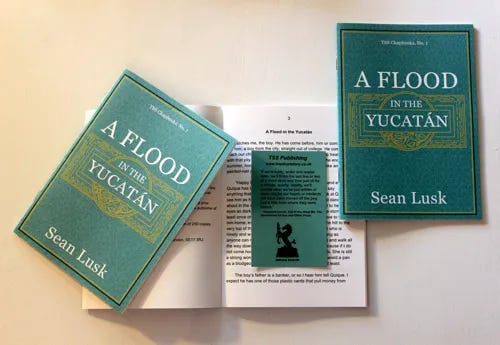
And herein lay the solution. I was going to take TSS old school: postal submissions.
Back to the days of personal submissions via Royal Mail. Back to the letterbox. Back to SAEs.
The lazy bastard is unlikely to go to the effort of formatting their work, printing off the piece, finding an envelope, sourcing a stamp and traipsing to the post-box. That’s far too much work for the lazy bastard, especially if they’ve a hunch they probably won’t get published in any case (AIS is, after all, still sub-par).
I don’t know if this will work as I hope. And there is definitely a wide vein of sadness to this move. I set up TSS in 2015, a few years after leaving university. I was young, enthusiastic and foolish. I sent interview questions to established writers, ran competitions, delighted in reading story after story. I loved it. I loved the reading, the discovery, the connections made. I learnt to read, write and edit more effectively and I felt part of a literary world, even if it was one I’d forced my nose into. But would I have the same enthusiasm today? Would I keep things going year after year?
With the rise of AI, I’m not so sure.
These challneges become all the more pronouncd if there’s money on the table - beyond kudos and credit, there’s a financial incentive to be a lazy bastard. Such a person could send out ten, twenty, thirty stories in the time it takes a real writer to work on one. And who knows, if they played the odds, they might get lucky.
Either way, one thing’s clear: when money’s involved, the stakes are higher and trust is imperative. It will be interesting to see how journals and publishers handle this in the future.
The literary journal plays a vital role in the world of publishing. It’s a place for new writers to test their voices and where scouts, agents and editors hear them.
The literary journal isn’t dead, but the landscape is radically changing. I think we should all consider how journals are to adapt if they’re to survive and remain part of the wider universe of readers and writers.
I’d love to hear readers’ thoughts on this and if you’d like to read the Mission Statement, you can do so here.
Who knows, you might even feel like sending something in the post. After all, we can’t let the lazy bastards win, can we?
I'm without question too lazy to submit to journals by post. But I came to nearly the same conclusion, and even bought envelopes and printed out the addresses of journals that accept postal submissions, because we always live in hope about ourselves, don't we
I love this stand against AI. I hope you don't mind me saying that in the grand scheme of things it is a gesture, because gestures can actually be important. I love this policy even though it causes me personally problems as I live in Cambodia, a country without a functioning postal service. So in order to submit to you I would have to get a friend in another country to print out and do it on my behalf. But I will still do that because I want to support your stand against AI (and also, hopefully, one day be accepted for publication).
AI has truly poisoned the writing world. I am not kneejerk against AI in all situations (it has levelled the field for a lot of people who don't speak English as a first language in international job markets) but in creative writing it is seeping in everywhere and is necrotic. I'm in writing groups where we've had to remove people for submitting AI writing/feedback and where there are people I am reasonably sure are still using it, but it's not possible to prove. AI is winning writing contests, appearing in journals I read, and has seeped into everything online.
And it really is deadly and soul-numbing stuff, all surface and no feeling as the Manic Street Preachers once presciently sang.
I do think it's possible that there may be a positive outcome from all of this in the long run. In my opinion, a lot of literary magazines have come to value unique phrasing, linguistic flourishes and style over old-fashioned stuff like character, plot, and deep heartfelt meaning. I think that the reaction against AI might mean psychological acuity and empathy make a comeback.
But I'm rambling. This is a fascinating post and I am glad you are clawing your way out of the despair Rupert. I've managed to just about keep myself from falling into total depression but have often thought that I wouldn't have if I was an editor.